
The Science of Strength, Creatine & Longevity.
At LYF Long, we believe ageing well isn't about chasing trends or hacking biology. It's about respecting the evidence and acting on it. The supplement industry is full of noise; we cut through it by grounding every product and protocol in decades of peer-reviewed research into how the body holds onto strength, energy, and clarity over time.
The science is clear: the choices you make after 35 compound, and small, consistent inputs, a daily dose of creatine, regular resistance training, quality sleep, produce outsized returns when sustained over years. It's not about perfection. It's about starting now and letting the compound effect work in your favour.
3–8%
muscle loss per decade from age 30 without intervention
5–15%
strength gain with creatine + resistance training
30+
years of peer-reviewed creatine research
3–5g
daily creatine dose shown to be safe and effective
Why Strength Matters More After 35
Here's something most people don't realise: from your mid-thirties onwards, you lose about 3–8% of your muscle mass every single decade if you don't do anything about it.[3] It's called sarcopenia, and while it isn't inevitable, it's what happens by default. The good news? Your body responds incredibly well to the right stimulus.
To understand why that matters so much after 35, it helps to look at how strength actually changes across a lifetime. The curve is steeper than most people expect. You hit peak muscular strength between about 25 and 35. After that, if you're sedentary, you lose roughly 1–2% of your strength per year, and that loss accelerates sharply once you pass 60. By the time you reach your eighties, the average untrained adult has less than half the strength they had at their peak, and power output, your ability to produce force quickly, drops even faster than raw strength.[13]
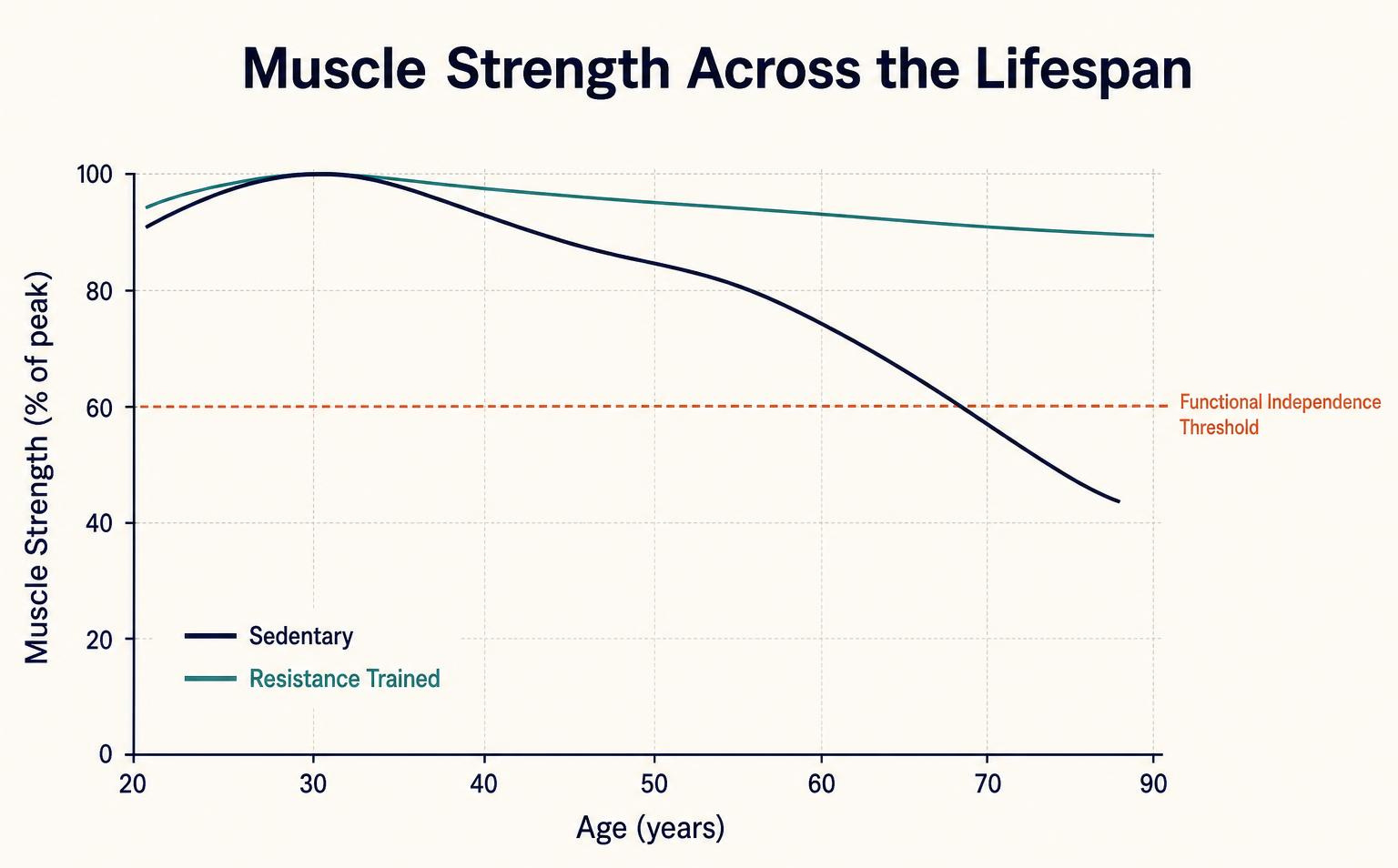
That decline isn't just about looking less toned, it directly impacts your ability to live independently. All the little things you barely think about, getting up from a chair, walking upstairs, carrying shopping, catching yourself when you trip, they all depend on leg strength and power. Once you drop below roughly 60% of your peak capacity, your safety margin in daily life shrinks dramatically. Falls become more likely, recovery from illness or injury takes longer, and loss of independence often follows.[3,9]
The single most effective way to bend that curve is resistance training, and it works at any age. Studies have shown adults in their seventies and eighties who start a structured strength program can gain 30–150% more strength within just 8–12 weeks, with noticeable improvements in walking speed, balance, and how quickly they can stand up from a chair.[2,5] The earlier you start, the more strength you preserve, but it's genuinely never too late to begin.
So where does creatine fit in? Once you're putting in the work, creatine helps you get more out of every session. It doesn't replace hard work, it amplifies it, you recover faster between sessions, make bigger gains from the same effort, and the benefits are proportionally largest for adults over 50.[1,2,5]
Creatine isn't a shortcut. It's a tool, one studied for over 30 years and consistently shown to improve strength, power, and recovery.
The Science-Backed Benefits of Creatine
How one supplement supports muscle and mind
Creatine is one of the most comprehensively studied supplements in nutritional science, with over 30 years of peer-reviewed research[1]. Its primary role is to replenish adenosine triphosphate (ATP), the energy currency your cells use for every muscular contraction and cognitive task[1]. This means it doesn't just help you lift heavier; it also supports working memory, processing speed, and mental resilience under load[4]. For adults over 35, that combined benefit on body and brain is especially powerful[2,4].
Muscle Strength & Power[1,2]
Creatine increases phosphocreatine stores in muscle, directly improving force production. Meta-analyses show 5–15% strength gains in trained individuals, with even greater effects in older adults beginning resistance training.
Cognitive Function[4]
The brain is metabolically expensive. Supplementation has been shown to improve working memory, processing speed, and cognitive resilience under stress. Particularly relevant with age.
Bone Health[5]
When paired with resistance training, creatine has been linked to improved bone mineral content and density in older adults. A meaningful countermeasure to age-related bone loss.
Recovery & Daily Function[6]
Creatine reduces markers of muscle damage after exercise and supports faster recovery between sessions, enabling more consistent, higher-quality training over time.
Body Composition & Metabolic Health[2]
By increasing fat-free mass, creatine helps support a higher metabolic rate and favourable body composition shifts when combined with resistance training, making it easier to maintain leanness over time.
Functional Power & Fall Prevention[9]
Creatine enhances rapid force production and muscular power: key determinants of balance and reactive strength. For adults over 35, this translates directly to reduced fall risk and greater functional independence.
Why Creatine Monohydrate Outperforms Every Other Form
Despite a steady stream of "advanced" alternatives, creatine monohydrate remains the most researched, most bioavailable, and most cost-effective form of creatine ever produced. Newer variants, hydrochloride, ethyl ester, buffered, liquid, have repeatedly failed to outperform it in head-to-head trials, and several are demonstrably less stable in the body[1,8].
Highest Bioavailability[1,8]
Studies consistently show creatine monohydrate reaches near-100% absorption in the small intestine, with full muscle saturation achievable in 3–4 weeks of daily use.
Unmatched Stability[8]
Creatine monohydrate remains chemically stable in powder form for years and in solution for hours. Ethyl ester and liquid forms degrade rapidly into inert creatinine.
30+ Years of Evidence[1]
Every major benefit, strength, power, cognition, recovery, bone density, has been demonstrated specifically with creatine monohydrate. Alternative forms have a fraction of the data.
The pattern is consistent across the literature: novel forms are marketed on theoretical advantages that disappear under controlled testing. Creatine monohydrate works because the molecule itself is small, stable, and water-soluble, the very properties that make it easy to manufacture, easy to absorb, and easy for your muscles to store.
Common Questions
Is creatine safe for long-term use?[1,8]
+
Yes. The International Society of Sports Nutrition has repeatedly confirmed creatine monohydrate as one of the safest supplements available, with no serious adverse effects documented in healthy individuals, even with multi-year use.
Do I need to 'load' creatine?[8]
+
Loading (≈20g/day for 5–7 days) speeds up muscle saturation, but it's optional. A steady 3–5g daily dose reaches the same saturation in about a month with fewer GI complaints.
Will creatine make me bloated or puffy?[8]
+
Creatine draws water into muscle cells. This is part of how it works. It's intramuscular water, not subcutaneous bloating. Most people notice no visual change; many look leaner as muscles become fuller.
Is creatine only for men?[7]
+
No. Women respond just as well to creatine supplementation, with comparable improvements in strength, power, and body composition, plus benefits unique to female physiology across the lifespan.
Should I cycle on and off creatine?[1]
+
There's no evidence that cycling provides any benefit. Consistent daily use maintains saturation and produces the best long-term results.
Does creatine cause hair loss?[10]
+
No. A recent 12-week RCT found no significant effect of creatine on hair shedding, scalp coverage, or serum DHT levels. The original concern came from a small 2009 study on rugby players that has never been replicated.
Is creatine bad for your kidneys?[11]
+
No. In healthy people, creatine does not harm the kidneys, even after years of use. One thing to know: your body turns creatine into a waste product called creatinine, which is the same thing doctors measure on a standard kidney blood test. So taking creatine can make that number look slightly high, and your estimated kidney score (eGFR) look slightly low, even though your kidneys are working perfectly fine. If your doctor wants a clearer picture, they can run a different test called cystatin C, which isn't affected by creatine.
Does creatine cause dehydration or muscle cramps?[12]
+
No. Creatine increases total body water, but this is stored inside muscle cells. Systematic reviews and large athletic cohorts show no increase in cramping, heat illness, or dehydration compared to placebo.
The Studies Behind the Claims
Every numbered citation on this page now links to a free full-text source wherever one is available. We encourage you to read them.
- [1]
Kreider RB, et al. (2017). International Society of Sports Nutrition position stand: safety and efficacy of creatine supplementation in exercise, sport, and medicine. J Int Soc Sports Nutr, 14:18.
Link to Study - [2]
Chilibeck PD, et al. (2017). Effect of creatine supplementation during resistance training on lean tissue mass and muscular strength in older adults: a meta-analysis. Open Access J Sports Med, 8:213–226.
Link to Study - [3]
Cruz-Jentoft AJ, et al. (2019). Sarcopenia: revised European consensus on definition and diagnosis. Age and Ageing, 48(1):16–31.
Link to Study - [4]
Chen X, et al. (2024). The effects of creatine supplementation on cognitive function in adults: a systematic review and meta-analysis. Front Nutr, 11:1424972.
Link to Study - [5]
Candow DG, et al. (2021). Current evidence and possible future applications of creatine supplementation for older adults. Nutrients, 13(3):745.
Link to Study - [6]
Cooke MB, et al. (2009). Creatine supplementation enhances muscle force recovery after eccentrically-induced muscle damage in healthy individuals. J Int Soc Sports Nutr, 6:13.
Link to Study - [7]
Smith-Ryan AE, et al. (2021). Creatine supplementation in women's health: a lifespan perspective. Nutrients, 13(3):877.
Link to Study - [8]
Antonio J, et al. (2021). Common questions and misconceptions about creatine supplementation: what does the scientific evidence really show?. J Int Soc Sports Nutr, 18:13.
Link to Study - [9]
Candow DG, et al. (2019). Effectiveness of creatine supplementation on aging muscle and bone: focus on falls prevention and inflammation. J Clin Med, 8(4):488.
Link to Study - [10]
van der Merwe J, et al. (2025). Does creatine cause hair loss? A 12-week randomized controlled trial. J Int Soc Sports Nutr, 22(sup1):2495229.
Link to Study - [11]
Poortmans JR, Francaux M. (1999). Long-term oral creatine supplementation does not impair renal function in healthy athletes. Med Sci Sports Exerc, 31(8):1108–1110.
Link to Study - [12]
Dalbo VJ, et al. (2008). Putting to rest the myth of creatine supplementation leading to muscle cramps and dehydration. Br J Sports Med, 42(7):567–573.
Link to Study - [13]
Mitchell WK, et al. (2012). Sarcopenia, dynapenia, and the impact of advancing age on human skeletal muscle size and strength; a quantitative review. Front Physiol, 3:260.
Link to Study
Ready to experience the benefits?
100% pure creatine monohydrate. Ultra Premium Quality, independently tested for purity and potency, because you deserve to know exactly what you're putting in your body.